The keys
The Tarot as a map of the universe
For Maestro Cornelio the Tarot does not predict the future: it is a book of images summing up the whole system of correspondences, from the Tree of Life to the elements.
Born in the Italian courts of the fifteenth century as a game, the Tarot has become over the centuries one of the richest symbolic systems of the Western tradition. Maestro Cornelio teaches it in a way that surprises those who know it only as a tool of divination: for him it is above all a map of the universe, a book of images that sums up the whole system of correspondences in seventy-eight cards.
An Italian origin
The first Tarot cards were painted in Milan and Ferrara around the middle of the fifteenth century, for families such as the Visconti and the Sforza: precious decks on gold grounds, used for a trick-taking game with the trump cards. Only at the end of the eighteenth century, in France, did some scholars begin to read them as a book of ancient wisdom, attributing them to Egypt. The Master recalls this history precisely, because the symbolic value of the Tarot needs no legendary origins: it lies in the structure of the cards.
The structure of the deck
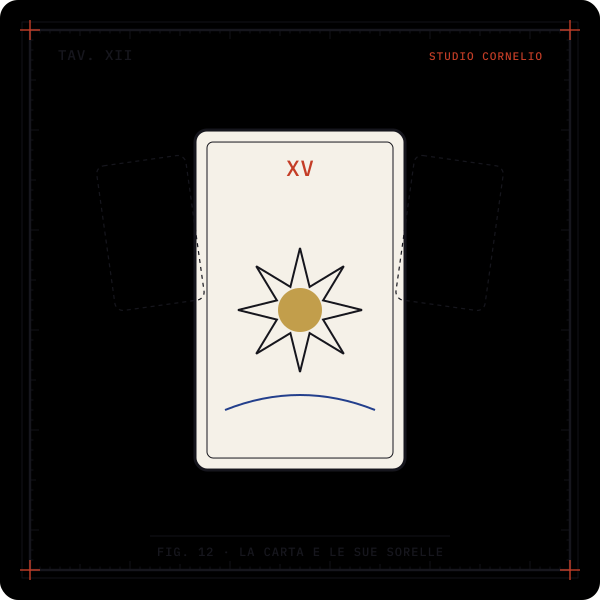
The deck is divided into two parts. The twenty-two major arcana, the trumps, from the Fool to the World, and the fifty-six minor arcana, divided into four suits: wands, cups, swords and coins. Each suit has ten numbered cards and four court cards. The Master shows how this structure overlaps perfectly with the other maps of the tradition: the twenty-two arcana with the twenty-two paths and twenty-two letters, the ten numbered cards with the ten spheres of the Tree, the four suits with the four elements.
Twenty-two images, ten numbers, four suits: the whole Tree in a hand of cards.
The Fool's journey
The Master suggests reading the major arcana as a journey. The Fool, the card with no number or with zero, is the being who sets out, free and unknowing, on the adventure of life. The following cards are the stages of the path: the encounter with will and knowledge, with nature and law, with love and choice, with trial and transformation, up to the World, the dancing figure at the centre of a garland, which represents fulfilment. It is not a story to be predicted, but a story to be recognised: every life travels it in its own way.
Mirrors, not verdicts
Here the Master distances himself from the most common use of the Tarot. The cards, he teaches, do not pronounce verdicts on the future: they are mirrors of present experience. When one meditates on a card, one does not ask "what will happen to me?" but "what of myself do I recognise in this image?". Used in this way, the Tarot becomes an extraordinary tool of self-knowledge, because its images speak directly to the imagination, bypassing the defences of reasoning.
The nameless arcanum
The Master pays particular attention to the arcana that frighten: the thirteenth card, often nameless, the Devil, the Tower. He teaches that these images too should be read as passages. The thirteenth is transformation: something ends so that something else can begin. The Devil is the chain binding us to what we believe we desire. The Tower is the collapse of false constructions, clearing the ground for true ones. No card is only negative: each points to a work to be done.
One card, one question
The exercise the Studio suggests is a daily meditation on a single arcanum. Each morning choose one card among the twenty-two, look at it for a few minutes without reading any explanation, and note three things: what you see, what you feel, what question the card asks. After twenty-two days the Fool's journey is complete, and one begins again. The Master assures us that by the second or third round the cards begin to speak: not of the future, but of the present one had been neglecting.
Watch the video
Read next
What magic is: the science and art of Will
The definition Maestro Cornelio places at the foundation of the whole teaching: magic is the science and art of causing change in conformity with Will.
The principles of magic: the fundamental rules
From the definition follow a few rules: every intentional act is magical, every failure reveals a neglected condition, every being has the right to fulfil its own Will.
Macrocosm and microcosm: as above, so below
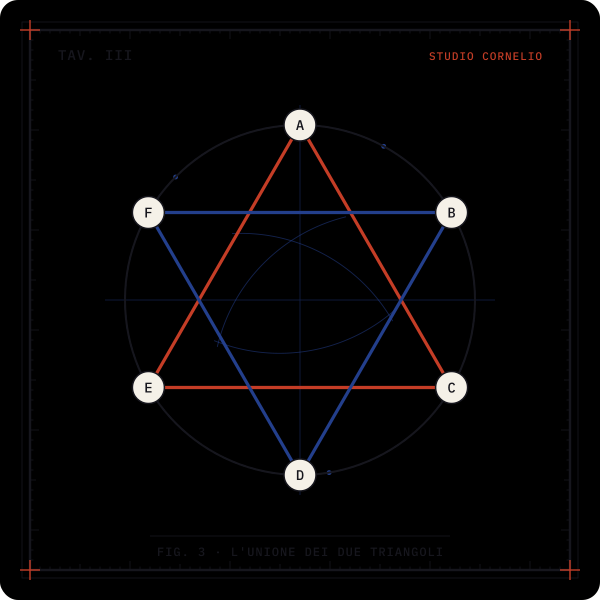
The human being as a small world reflecting the great world: the principle that grounds every correspondence, explained by Maestro Cornelio through the hexagram.
