Principles and definitions
The principles of magic: the fundamental rules
From the definition follow a few rules: every intentional act is magical, every failure reveals a neglected condition, every being has the right to fulfil its own Will.
Once magic has been defined as the science and art of Will, Maestro Cornelio draws from it a few principles, which he sets out with the sobriety of a treatise. They are not dogmas: they are working rules, to be tested in experience. The Studio presents them as the foundations on which all the other plates rest.
First principle: every intentional act is a magical act
The first principle follows directly from the definition. If magic is causing change according to a will, every deliberate gesture falls within the field of magic. The Master draws a lesson in responsibility from this: there are no neutral gestures. Every action performed with intention strengthens or weakens the direction of our life.
Second principle: every failure reveals a neglected condition
When a work does not succeed, the Master teaches, one should blame neither fate nor the ill will of others. One should look for the condition that was neglected: missing knowledge, a force misjudged, a confused intention. It is the attitude of a scientist faced with a failed experiment. Failure thus becomes a stern but precious teacher, because it shows exactly where there is still something to learn.
Third principle: one must know the conditions
It follows that to cause a change one must know the conditions in which one is working: the nature of the forces involved, their relationships, their limits. The sciences of the tradition, from the planetary correspondences to the Tree of Life, serve exactly this purpose: they are maps of forces, built and refined by generations of observers. The Master teaches them as one teaches a language: first the grammar, then the poetry.
Every failure shows that one or more conditions have been neglected.
Fourth principle: the human being does not know their own nature
The greatest obstacle, however, is not ignorance of the world but ignorance of oneself. The human being, the Master observes, knows little of their own nature and powers: they live in a small part of their possibilities, like someone who inhabits a single room of an immense palace. The science of magic is first of all the exploration of this palace. Every discipline of the tradition, from silence to concentration, opens a new room.
Fifth principle: every force can be transformed
The universe, the Master teaches, is made of forces that turn into one another: heat becomes motion, motion becomes light. The same happens in the human being. Fear can become prudence, anger courage, scattered desire a concentrated will. Magic does not destroy inner forces: it transforms and directs them. This is why alchemy, with its phases of dissolution and recomposition, has always been considered the sister of magic.
Sixth principle: the right to fulfil one's own Will
The last principle is also the first of the Law: every human being has the right, and the duty, to fulfil their own Will. The Master places it among the principles of magical science because it sets its ethical limit. A magic that violates another's orbit, that claims to bend another's will, does not conform to the Law: it is disharmony, and like every disharmony it ends up turning against whoever produces it. The magician works on their own orbit, not on other people's.
The harmony of the monochord
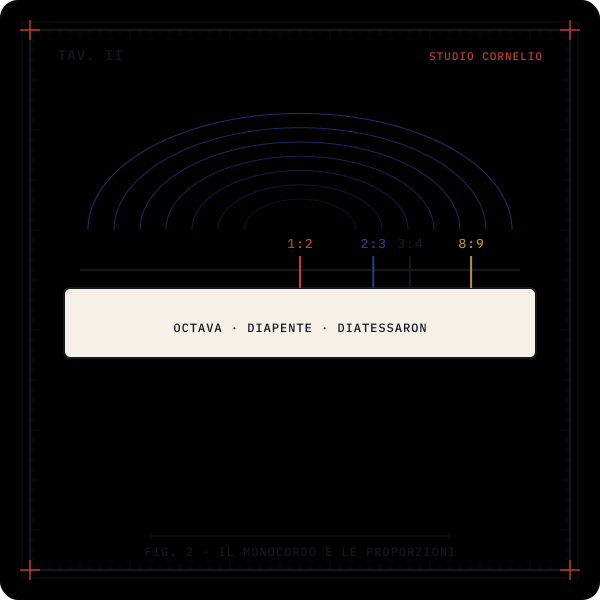
The plate for this entry shows a monochord, the single-stringed instrument with which the Pythagoreans studied musical proportions: half the string gives the octave, two thirds the fifth, three quarters the fourth. The Master uses it as an image of the principles. A string vibrates well only if it is stretched to the right tension and divided in the right proportions; too tight and it snaps, too slack and it does not sound. So it is with life: the principles of magic serve to find the right tension, in which the human being resonates with the universe.
Watch the video
Read next
What magic is: the science and art of Will
The definition Maestro Cornelio places at the foundation of the whole teaching: magic is the science and art of causing change in conformity with Will.
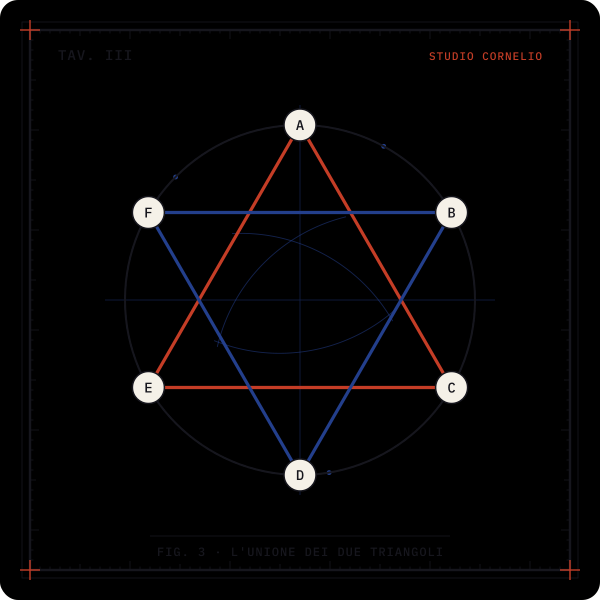
Macrocosm and microcosm: as above, so below
The human being as a small world reflecting the great world: the principle that grounds every correspondence, explained by Maestro Cornelio through the hexagram.
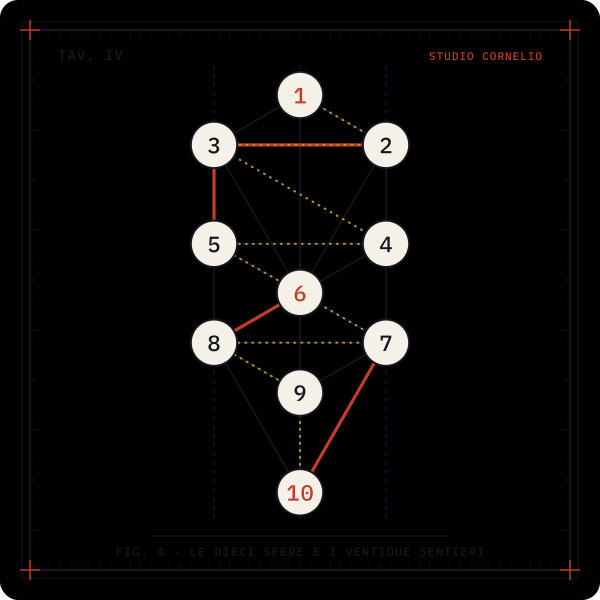
The Tree of Life: ten spheres, twenty-two paths
The great map of the tradition: ten spheres, twenty-two paths, three pillars. How Maestro Cornelio teaches us to read the Tree of Life as a chart of the universe and of the soul.
