The Tree and its paths
The Tree of Life: ten spheres, twenty-two paths
The great map of the tradition: ten spheres, twenty-two paths, three pillars. How Maestro Cornelio teaches us to read the Tree of Life as a chart of the universe and of the soul.
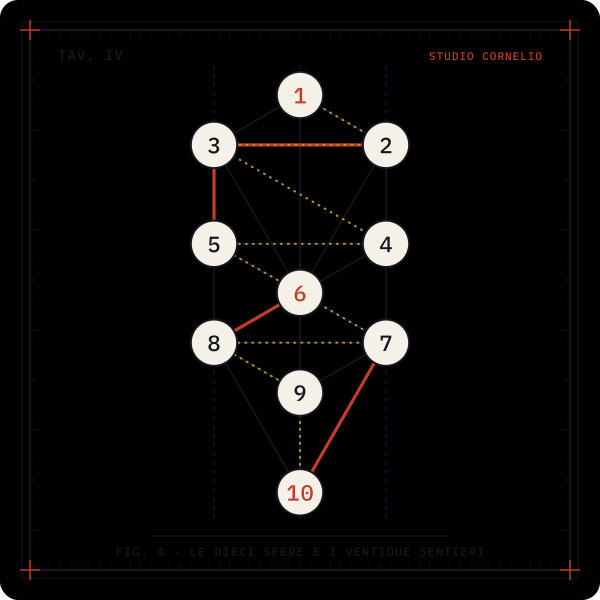
Of all the diagrams of the tradition, Maestro Cornelio points to one as the map of all the others: the Tree of Life. Ten spheres arranged on three columns, joined by twenty-two paths. At first sight it is a very simple drawing that can be traced with ruler and compass in a few minutes; yet whole generations of students of the Kabbalah have laid out on it everything they knew of the universe and the soul.
An ancient origin
The image of the cosmic tree is universal: the axis of the world joining heaven, earth and underworld appears in a great many cultures. The specific form of the Tree of Life, however, was born in the Jewish mystical tradition, the Kabbalah, which in the Middle Ages described the ten sefirot, the emanations through which the Infinite becomes manifest. In the Renaissance Christian philosophers, from Pico della Mirandola to Reuchlin and Agrippa, made it a key to their wisdom. The Master teaches it as a language shared by all these traditions.
The ten spheres
The spheres are numbered from top to bottom. The first, the Crown, is the point at which the Infinite begins to manifest; the tenth, the Kingdom, is the concrete world we live in. Between them lie Wisdom and Understanding, Mercy and Severity, Beauty at the centre, Victory and Splendour, the Foundation. Each sphere is a quality of being and at the same time a level of consciousness. The Master teaches us to think of them not as distant places, but as rooms each of us carries within.
Ten spheres and not nine, ten and not eleven: understand with wisdom and be wise with understanding.
The three pillars
The spheres are arranged on three vertical columns, which the plate for this entry marks with dashed lines. The right-hand column is that of mercy, expansion, giving; the left-hand column is that of severity, form, limit; the central column is that of balance. The Master draws a practical teaching from this: whoever lives only in expansion is scattered, whoever lives only in severity grows rigid. The path climbs the middle column, where the two forces are balanced.
The twenty-two paths
The spheres are linked by twenty-two paths, which tradition associates with the twenty-two letters of the Hebrew alphabet and, in modern times, with the twenty-two major arcana of the Tarot. If the spheres are states of being, the paths are passages: experiences that lead from one state to another. To travel a path is to be transformed. This is why the Master says that the Tree is not only studied: it is travelled.
Descent and ascent
The Tree is read in two directions. From top to bottom, it describes creation: light descending from the Crown to the Kingdom along the lightning flash. From bottom to top, it describes return: the path of the soul climbing from the concrete world back towards the source. The Master teaches that the two movements do not exclude each other. Light descends so that the soul may rise; the soul rises so that light may illuminate the world it sets out from.
A map, not the territory
The Master's last warning concerns the use of the diagram. The Tree is an extraordinary map, but it remains a map. Whoever learns its names by heart without travelling its roads is like someone who knows the atlas but has never travelled. This is why the Studio suggests a simple exercise: draw the Tree by hand, with ruler and compass, slowly, sphere after sphere. Drawing is already a way of travelling; and the drawing, repeated, imprints itself on the mind like a house one keeps coming back to.
Watch the video
Read next
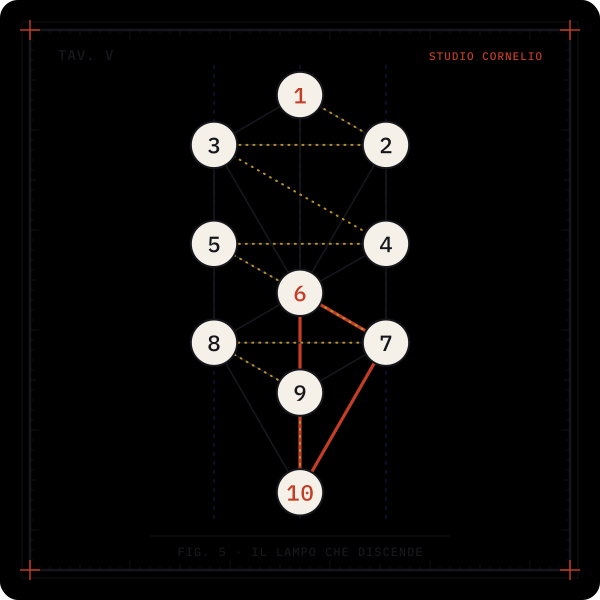
The lightning flash: the descent of light
The zigzag course by which light descends from the first to the tenth sphere of the Tree of Life: Maestro Cornelio explains it as an image of creation and inspiration.
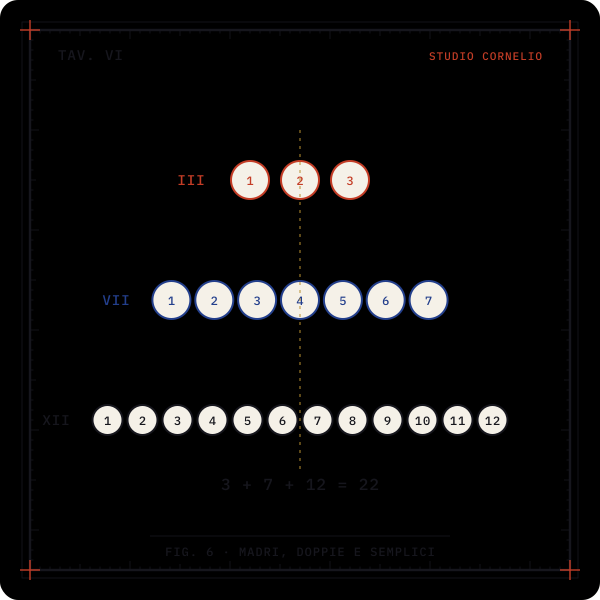
The twenty-two letters: mothers, doubles and simples
The Sefer Yetzirah describes creation through twenty-two letters divided into three families. Maestro Cornelio explains why letters are stones with which the world is built.
What magic is: the science and art of Will
The definition Maestro Cornelio places at the foundation of the whole teaching: magic is the science and art of causing change in conformity with Will.
