Figures and instruments
The pentagram: spirit above the elements
The five-pointed star traced in a single line: Maestro Cornelio explains it as the figure of the complete human being, in whom spirit governs the four elements.
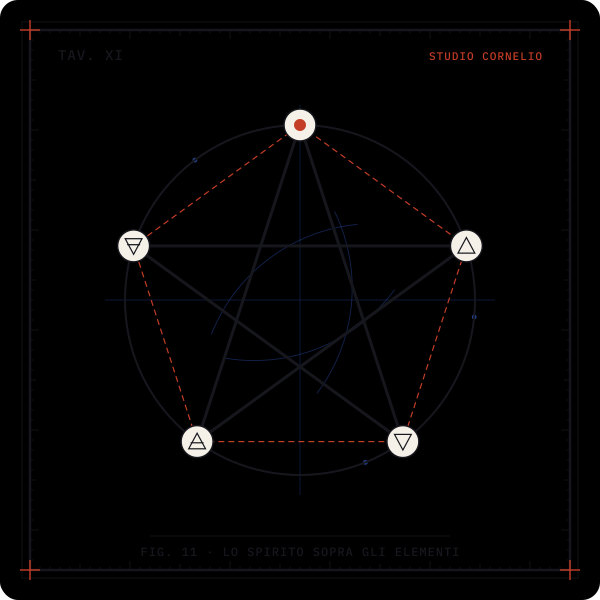
The five-pointed star is one of the oldest and most misunderstood signs in human history. It is traced with a single continuous line, without lifting the pen from the paper, and always returns to its starting point. Maestro Cornelio considers it the figure of the complete human being: spirit governing the four elements.
A single line
The first thing the Master points out is how the pentagram is drawn. One line, five segments, no interruption: the figure is a course that closes on itself. For the Pythagoreans, who made it their sign of recognition, it was the symbol of health and harmony. Its proportions contain the golden ratio everywhere: each segment is divided by the crossings in the proportion nature uses to make shells and flowers grow.
Pentagram and pentacle
Tradition often distinguishes between the pentagram, the traced star, and the pentacle, a disk on which the star or other signs are engraved. The Master clarifies the difference to avoid confusion: the pentagram is a geometric figure and a gesture; the pentacle is an object, one of the symbolic instruments of the tradition, linked to the element of earth and to concrete work.
Five points, a single line: spirit passing through the elements without ever breaking off.
Spirit above the elements
The most important meaning of the pentagram, in the tradition the Master teaches, concerns the elements. The four lower points correspond to fire, water, air and earth; the upper point to spirit. The plate for this entry marks the symbols of the elements at the four vertices and a red dot at the highest one. The upright star represents the right order: spirit governing matter, consciousness directing forces.
The human being in the star
In the Renaissance the pentagram was also read as a figure of the human body: the head at the top, arms and legs spread to the four corners. Agrippa and other authors drew the human being inscribed in the star, with the planets placed on the limbs. The Master sees in this the same idea as the microcosm: the human being carries within the structure of the universe, and the pentagram is its geometric signature.
Upright or reversed
Much of the pentagram's bad reputation comes from the reversed star, with two points up and one down. The Master explains its traditional meaning without sensationalism: to reverse the star is to place the elements above spirit, matter above consciousness. It is not a sign to be feared, but an image of disorder to be recognised. Each of us sometimes lives with a reversed star, whenever we let impulses govern the will. The work is to set the star upright again.
The knight's shield
The Master likes to recall a literary episode: in the fourteenth-century English poem Sir Gawain and the Green Knight, the pentagram is painted on the hero's shield and explained line by line as a symbol of five virtues multiplied by five. It is a sign of integrity: an endless knot in which each virtue supports the others. The Master suggests reading the star this way: not as an amulet, but as a promise of coherence.
An exercise of the star
The Studio associates an exercise of review with the pentagram. In the evening, trace the star slowly with your finger, and at each point ask: did I act with courage today (fire)? did I welcome what happened (water)? did I think clearly (air)? did I finish what I had to do (earth)? and finally, at the highest point: was all this directed by my Will? The Master teaches that the star is drawn with a single line in this sense too: the five questions are one, asked in five ways.
Watch the video
Read next
The circle: the space of Will
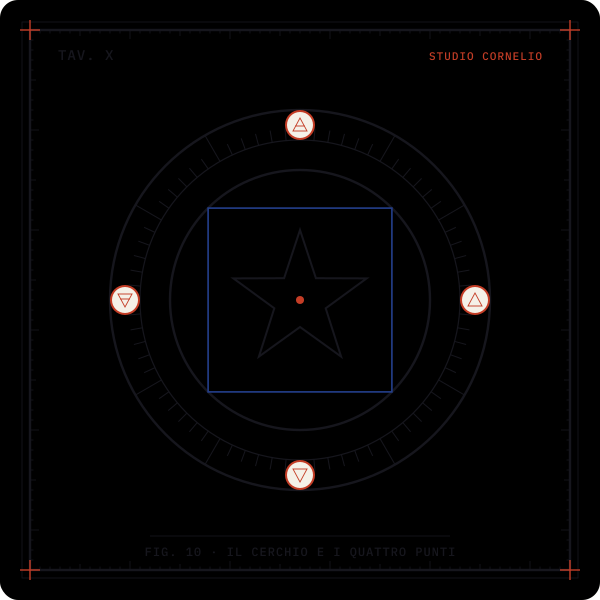
In a great many traditions the first gesture is to trace a circle. Maestro Cornelio explains the circle as the boundary of attention, setting the space of the work apart from ordinary space.
What magic is: the science and art of Will
The definition Maestro Cornelio places at the foundation of the whole teaching: magic is the science and art of causing change in conformity with Will.
The principles of magic: the fundamental rules
From the definition follow a few rules: every intentional act is magical, every failure reveals a neglected condition, every being has the right to fulfil its own Will.
